
In C.S. Lewis’ On Reading Old Books we read:
Every age has its own outlook. It is specially good at seeing certain truths and specially liable to make certain mistakes. We all, therefore, need the books that will correct the characteristic mistakes of our own period. And that means the old books.
All contemporary writers share to some extent the contemporary outlook—even those, like myself, who seem most opposed to it. Nothing strikes me more when I read the controversies of past ages than the fact that both sides were usually assuming without question a good deal which we should now absolutely deny. They thought that they were as completely opposed as two sides could be, but in fact they were all the time secretly united—united with each other and against earlier and later ages—by a great mass of common assumptions.
We may be sure that the characteristic blindness of the twentieth century—the blindness about which posterity will ask, “But how could they have thought that?”—lies where we have never suspected it, and concerns something about which there is untroubled agreement between Hitler and President Roosevelt or between Mr. H. G. Wells and Karl Barth. None of us can fully escape this blindness, but we shall certainly increase it, and weaken our guard against it, if we read only modern books.
I came across a great example of this today, while reading Norms and Nobility by David Hicks (1981), the pioneering work in the renewal of classical Christian education.
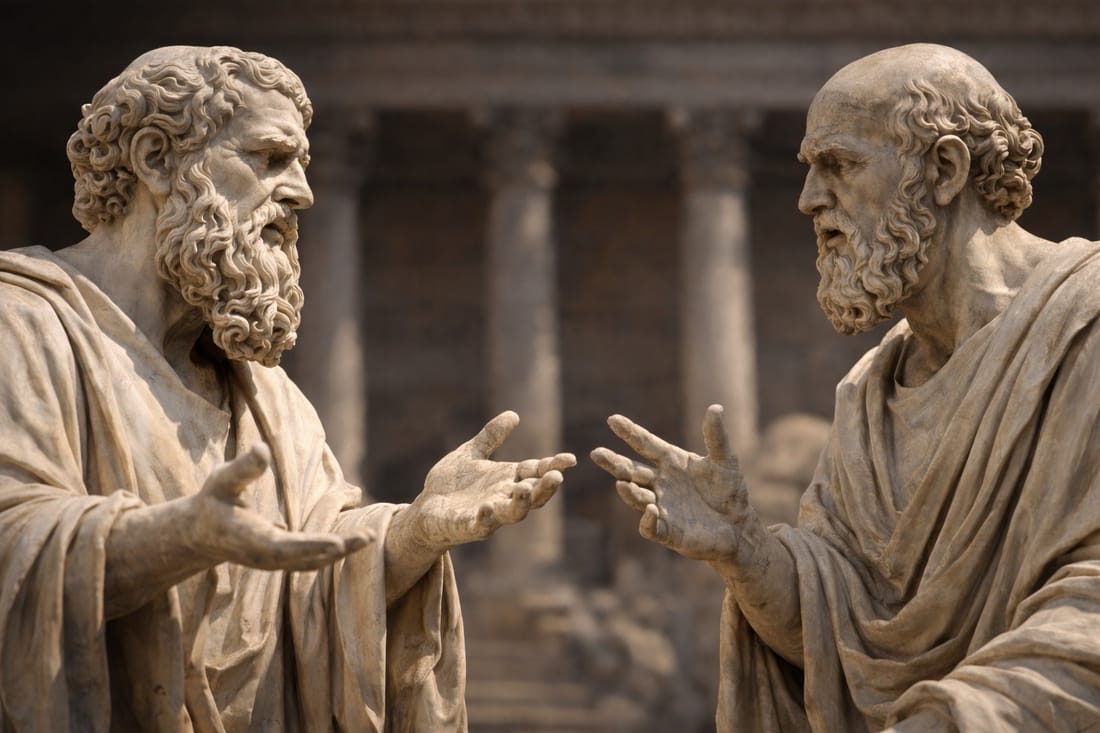
Whereas Plato [the philosopher] recognized beauty in truth, the rhetorician saw truth in beauty; more than that, the rhetorician believed that whenever truth comes to man by way of beauty, it necessarily transforms his character and ennobles his behavior. Virtue, in his view, grows out of the beautiful adornments of dogma, not from the inelegant dialectic of philosophy. Conscience springs from style. “The right word,” the great rhetorician Isokrates (Marrou 1964) taught, “is a sure sign of good learning.” Learning to speak properly causes the student not only to think but to live properly. “In the eyes of the Ancients,” writes Marrou (1964), “eloquence had a truly human value transcending any practical applications … it was the one means for handing on everything that made man man, the whole cultural heritage that distinguished civilized men from barbarians. The idea underlies all Greek thought, from Diodorus Siculus to Lianius.”
Not only did philosopher and rhetorician share the purpose of teaching virtue, but both borrowed freely from the methods of each other. The philosopher’s pretense of scorning style was eloquent indeed, and perhaps no one has ever written with more urgency and acumen on the connection between poetry and right conduct than Plato. The rhetorician, for his part, may not have flaunted a search for truth or professed belief in man’s innate goodness, but his learned recitations are everywhere infused with love of truth and with intimations of virtue in his listeners to which he makes appeal. Philosophical and rhetorical learning—as two rival approaches to education—enriched classical culture without disturbing its profound unity. But in the modern era, we watch helplessly as the near lockstep uniformity of state and private education emasculates learning and impoverishes culture. The lesson of the ancient quarrel between philosopher and rhetorician seems unimportant. Do we not understand that conflict which shares its purposes is good and that uniformity does not mean unity any more than conformity signifies independent and intelligent agreement? So long as the ancient quarrel persisted, it fired both sides with an intellectual passion for learning and helped to personalize, as well as to achieve, the goals of education. Both philosophers and rhetoricians hoped to demonstrate the efficacy of their respective methods by pointing to the virtuous lives of their students. Each side competed for the same prize, the formation of the virtuous man; each directed his opponent’s attention to moral ends by attacking the other’s tendency to become bogged down with intellectual or utilitarian concerns. With the unchallenged ascendency of the analytical methods of science, however, something of this healthy debate has gone out of modern education, and with it, the excitement of intellectual passion that makes the school a place where virtue can be taught.
For the ancients, the debate was over whether virtue (goodness) could be taught, and whether in doing so, truth came first and led to beauty (the view of philosophers) or beauty came first and led to truth (the view of rhetoricians). The underlying assumption—the agreement between both which we are missing and are blind to in modern education—was that a love of Beauty, Truth and Goodness should be pursued; that the end of education was the development of a virtuous man.
The Current Predicament
Today it looks like there is no agreement between proponents of modern, progressive education and those of classical Christian education. If Lewis is right though, in the eyes of future generations our aims will not be so dissimilar. Hicks work can be of help to us here as well:
According to Aristotle, the perfect end of education will be an activity that is engaged in for its own sake, complete and sufficient unto itself. Aristotle calls the activity for which education prepares man—happiness. So far, all might agree. But as to the nature of happiness, the opinion of mankind is divided. Many believe that happiness attends the life of pleasure; others credit the practical life with producing happiness; but the wise—Aristotle has no doubt—find it in the theoretic [or contemplative] life, as the true end of education.
According to Aristotle, the modernist progressives and we classicists are in agreement: The purpose of education is the pursuit of happiness. The problem is that we have very different views of happiness. In Nicomachean Ethics, Aristotle identifies three prevailing views of the source of happiness.
Life of Pleasure
The pursuit of pleasure as our means to happiness is to be controlled by our appetites. Aristotle says that this is the view that most have of happiness, but that it is “slavish,” and “only a life for cattle.” Still, he says we must address it because even “many persons of high position share the feelings.” A life of pleasure is fleeting, and cannot satisfy.
On the one hand the generality of men and the most vulgar identify the Good with pleasure, and accordingly are content with the Life of Enjoyment…The generality of mankind then show themselves to be utterly slavish, by preferring what is only a life for cattle; but they get a hearing for their view as reasonable because many persons of high position share the feelings of Sardanapallus.
Life of Politics
For those who seek happiness through politics, that happiness is gained when they are honored. The problem is, that this too is fleeting. It is dependent on others to confer this honor, and leaves the judgement of our worth in their hands.
Men of refinement, on the other hand, and men of action think that the Good is honour—for this may be said to be the end of the Life of Politics. But honour after all seems too superficial to be the Good for which we are seeking; since it appears to depend on those who confer it more than on him upon whom it is conferred, whereas we instinctively feel that the Good must be something proper to its possessor and not easy to be taken away from him. Moreover men’s motive in pursuing honour seems to be to assure themselves of their own merit;
Life of Contemplation
The wise, Aristotle says, find happiness in their pursuit of virtue (ἀρετή, arete, meaning excellence) through contemplation. Accordingly, he says, contemplation is the highest activity that we can take part in. It is also the activity that we can perform most continuously, and is the “most self-sufficient” of all activities in that it requires no one else to be around.
But if happiness consists in activity in accordance with virtue, it is reasonable that it should be activity in accordance with the highest virtue; and this will be the virtue of the best part of us. Whether then this be the intellect, or whatever else it be that is thought to rule and lead us by nature, and to have cognizance of what is noble and divine, either as being itself also actually divine, or as being relatively the divinest part of us, it is the activity of this part of us in accordance with the virtue proper to it that will constitute perfect happiness; and it has been stated already that this activity is the activity of contemplation.
And that happiness consists in contemplation may be accepted as agreeing both with the results already reached and with the truth. For contemplation is at once the highest form of activity (since the intellect is the highest thing in us, and the objects with which the intellect deals are the highest things that can be known), and also it is the most continuous, for we can reflect more continuously than we can carry on any form of action. And again we suppose that happiness must contain an element of pleasure; now activity in accordance with wisdom is admittedly the most pleasant of the activities in accordance with virtue: at all events it is held that philosophy or the pursuit of wisdom contains pleasures of marvellous purity and permanence, and it is reasonable to suppose that the enjoyment of knowledge is a still pleasanter occupation than the pursuit of it. Also the activity of contemplation will be found most self-sufficient, to possess in the highest degree the quality that is termed self-sufficiency; for while it is true that the wise man equally with the just man and the rest requires the necessaries of life, yet, these being adequately supplied, whereas the just man needs other persons towards whom or with whose aid he may act justly, and so likewise do the temperate man and the brave man and the others, the wise man on the contrary can also contemplate by himself, and the more so the wiser he is; no doubt he will study better with the aid of fellow-workers, but still he is the most self-sufficient of men.
The Solution
In Greek the word rendered happiness is εὐδαιμονία (eudaimonia), and it’s what the American founders would have had in mind when they wrote of that we are “endowed by [our] Creator with certain unalienable Rights, that among these are Life, Liberty and the pursuit of Happiness.” Happiness here is the freedom to live a life of the highest virtue. It is a state of human flourishing, which is desirable in and of itself. It is not a means to some other end (e.g. pleasure or honor). It’s what Aristotle viewed as the Contemplative Life.
Much like in Aristotle’s day, the majority of Americans view pleasure as the highest good, and they pursue whatever currency (money, fame, etc) that can be used to feed those appetites (power, sex, status). Modern educators leave us on similarly shaky ground. “Study hard so that you can get a great paying job, or move up in society.”
Classical Christian educators must reject these modern notions of happiness and urge our students towards the Contemplative Life. For we even see in God’s word that we are to “set our minds on things above,” (Colossians 3:2-6) and think on higher things (Philippians 4:8).
As educators, we must learn even now to embrace conflict in and our of our own camps. We must understand that we are all pursuing the same goal, but have very different understandings of what that goal is, and how to get there. We must debate and sharpen one another without it spiraling into a unending turf war.
Member discussion